What's going on?
The Monty Hall Problem
This website is about the Monty Hall Problem, a famous brain teaser. The best-known version was asked to columnist Marilyn vos Savant in 1990:
Suppose you’re on a game show, and you’re given the choice of three doors. Behind one door is a car, behind the others, goats. You pick a door, say #1, and the host, who knows what’s behind the doors, opens another door, say #3, which has a goat. He says to you, "Do you want to pick door #2?" Is it to your advantage to switch your choice of doors?
The answer is yes. Switching to the other door doubles your chances of getting the car. Many people find this counterintuitive, and think that switching shouldn't make a difference. Even mathematicians can get tripped up by this problem (vos Savant answered correctly and got a lot of angry letters disagreeing!) There are a lot of good explanations of the original Monty Hall Problem online: I like this one from Numberphile.
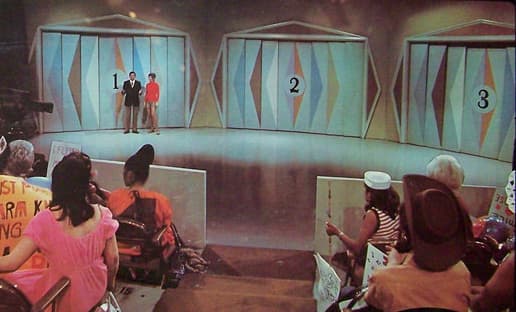
The problem is named for Let's Make a Deal host Monty Hall, though the show didn't really work the way it does in the problem.
However, the wording of the puzzle doesn't always emphasize a key aspect: the host knows where the car is, and will always open a door with a goat behind it.
If the host doesn't know where the car is, and opens one of the other doors at random, it is not better to switch. Even if he revealed a goat!
A lot of people who have heard the original Monty Hall Problem get this wrong. And because the Monty Hall Problem is famously counterintuitive, it's easy to get this version wrong and then double down, thinking that your answer only seems wrong because the puzzle is so tricky.
But it's true: If Monty randomly opens a door with a goat behind it, there's no reason to switch. If Monty deliberately opens a door with a goat behind it, you should switch. It makes a difference whether Monty knows.
Why is this true?
Understanding why is a lot easier once you've demonstrated to yourself that it is true. So if you have doubts, on the main page you can play the game both ways. (Keep in mind that if Monty doesn't know where the car is, he might accidentally reveal it, ending the game early!) Try or simulate it as many times as you like: when Monty doesn't know where the car is, then if he reveals a goat, there's no advantage to switching. If you don't trust the website, you can try it yourself with some playing cards.
There are also ways to prove this rigorously, by drawing tree diagrams or writing probability formulas that cover all cases. This website is not about that (yet). I'm going to use as little mathematical terminology as I can. But make no mistake, this strange result is true. What this website is about is trying to explain conceptually, intuitively, how this can be possible.
Because I don't blame anyone for getting confused! Why does it matter if Monty knows where the goats are, if the problem states that he does reveal a goat? Math doesn't care about "beliefs" or "intentions," right? If Monty does the same thing in both situations, how can it make a difference why he does it?
Here are some ways to think about it:
Monty's behavior is forced
One cause of confusion is that the problem is usually worded as "the host knows what's behind the doors." But to be fair, we don't quite care about what Monty's "knowledge," his psychological state. The phrase "the host, who knows what's behind the doors, opens a door which has a goat" really means this:
The host never would have opened a door with the car behind it.
Or if you prefer, the host cannot open a door with a car behind it. It's just not possible. Maybe he knows where the car is and chooses not to reveal it, maybe he knows nothing but is being fed instructions through an earpiece. Maybe he's been magically cursed to never reveal a car. The puzzle works either way: the point is, the puzzle relies on the host's predictable behavior, not his knowledge. After all, the host in this simulated version is just a few lines of code - I'm not sure it "knows" anything!
Why does the host's predictable behavior matter? Set the switch to "Monty Doesn't Know" and play or simulate a lot of tries. Whether you switch or stay, about 1/3 of the time, he reveals a goat, and you win. And 1/3 of the time, he reveals a goat and you lose. But also, 1/3 of the time, Monty accidentally reveals the car, ending the game. So when Monty doesn't know, you have an even chance of winning when Monty reveals a goat whether you switch or stay - but there are also these extra cases where Monty reveals the car.
(You might be bothered by me saying Monty revealing the car "ends the game early": where did I get that rule? But since the puzzle asks about what happens when Monty reveals a goat, it doesn't actually matter what happens if he reveals a car. We could say that means you automatically lose, in which case you have a 1/3 chance of victory no matter your strategy. Or it could count as a win, and you have a 2/3 chance of victory no matter what you do. Or just discard those cases entirely. Regardless, in the cases where Monty reveals a goat, there's no difference in your success rate if you switch or stay.)
So when Monty choose randomly, he reveals the car 1/3 of the time: what if we make it so he can't reveal the car? What if (because he knows where the car is, or through a magical curse, or whatever) he will never open the door with the car behind it?
Well, when Monty's choosing randomly, he could only reveal the car if the original door you picked has a goat behind it. That would leave him with two doors, one with a car and one with a goat: half the time, he'll reveal a car. The other half of the time, he'll reveal a goat - those are the cases when it's better to switch, because the car is behind the remaining door! If instead, he always reveals the goat, that means that every time you initially choose a goat, it has to become one of those cases when it's better to switch. Because every time you initially choose a goat, he has to open the door with the other goat!
If Monty doesn't know, 1/3 of the time you should switch, 1/3 of the time you should stay, 1/3 of the time he reveals the car. If he does know, then all the times when he would have revealed the car become times where it's better to switch, yielding the result in the original problem: switching wins 2/3 of the time.
It's about information
The above explanation... makes a little sense, maybe? If you're mathematically inclined and love drawing tree diagrams, it might be enough. But I find it unsatisfying - it doesn't tackle the weirdness of this problem. Because it really feels like both situations are the same! You point to a door, Monty reveals a goat, not a car: why should we care about hypotheticals that didn't actually happen? What do I even mean, times turn into different times? The problem tells us what's happened. So why do we care what could have happened, but didn't?
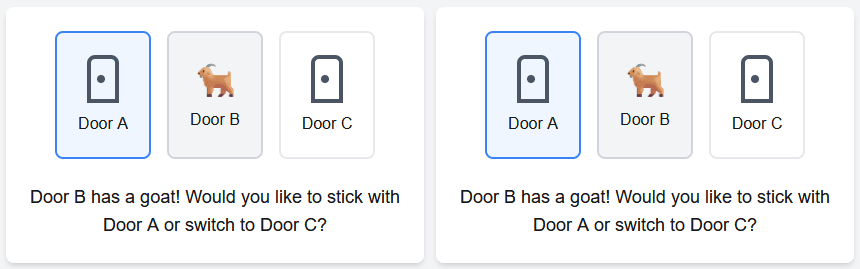
On the left: what it looks like when Monty deliberately reveals a goat. On the right: what it looks like when Monty accidentally reveals a goat.
Here's a different way to think about it: you're looking for information. You're like a detective, hunting for clues. And the same object can be a different clue depending on where it came from. If there's a bootprint in the hall, it matters if the victim wore boots or not. If the window was open on the night of the crime, it matters if someone leaves it open every night, or if it was just open this once. The same event means something different depending on how rare it is - it gives you different information.
What information is Monty giving us? It might make more sense to think in this way: when he deliberately reveals a goat every time, what information is he hiding? Try to picture exactly what it's like when Monty chooses randomly:
You've pointed at one of the doors. You don't know where the car is, but you hope you're pointing at it! Monty randomly opens a different door. There's a goat behind it.
...Don't you feel better about your choice now? You know that at least you aren't pointing at that goat! You breathe a sigh of relief, because it feels like the probability you're pointing at the car has gone up!
And it has! A lot of people hear slightly garbled explanations of the original Monty Hall problem, which will say things like: pointing to a door at the start "locks in" a 1/3 probability that the car's behind it. There's a 2/3 probability it's behind one of the other two doors - so when Monty reveals a goat behind one of them, there's a 2/3 chance it's behind the remaining door.
But probabilities don't inherently "lock in" like that! They absolutely change in response to new information. If you're playing a card game, and you hope your opponent isn't holding an ace, you feel better if you see three aces dealt from the deck onto the table. Even though the aces were dealt after they were already holding their hand, they still give useful information: there's only one ace left, the odds are low that it happens to be among their cards.
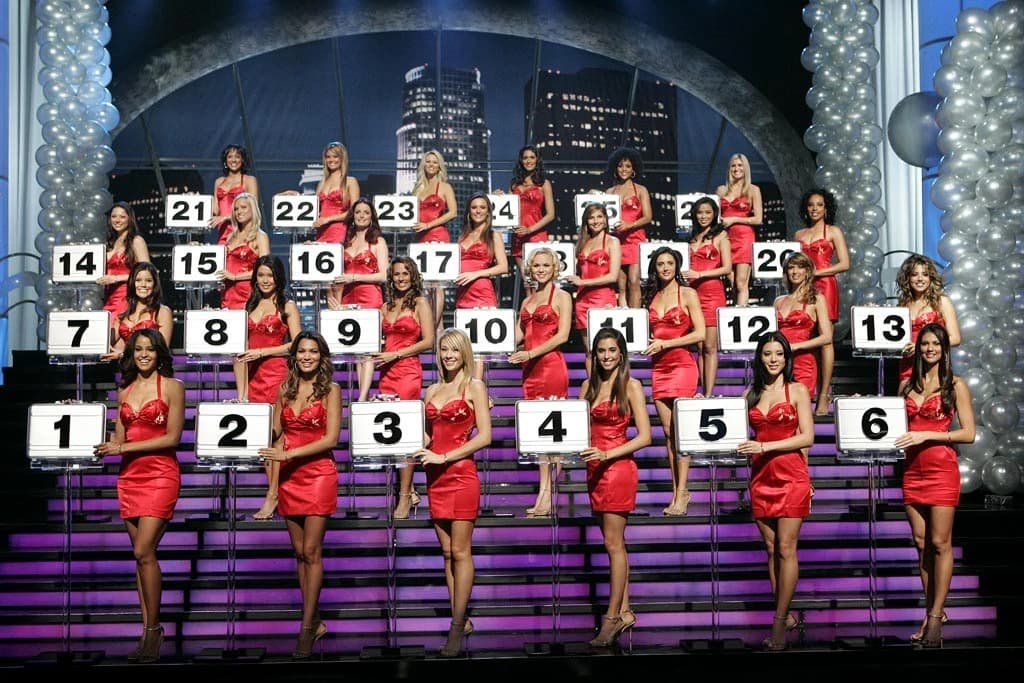
When Monty doesn't know, the puzzle is kind of like a different game show: Deal or No Deal. That show has a set of briefcases containing different amounts of money, ranging from $0.01 to $1,000,000. The contestant chooses a briefcase, and during the show, more and more of the remaining briefcases are opened, revealing what's inside. When small amounts of money are revealed, contestants sigh with relief! It means that that small amount can't be in the briefcase you're holding. Each case contains a different number of dollars, and every time you reveal a low number, your expected value goes up.
Similarly, when Monty randomly opens a door to reveal a goat, it means you can't be pointing at that goat. It makes it likelier that you're pointing at the car - to be exact, that information raises your probability from 1/3 to 1/2!
But when Monty is deliberately only revealing goats, he's hiding that information from you. You don't learn anything when he reveals a goat... because you already knew he would reveal a goat!
Like a window left open, the same event means something different if it was guaranteed or uncertain. If Monty doesn't know where the car is, then if you initially chose the door with the car, he was guaranteed to reveal a goat. But if you chose one of the goats initially, he only had a 1/2 chance of revealing a goat. That's why if he reveals a goat, it lets you know the chances have gone up that the door you're pointing at has the car.
But if he's definitely going to reveal a goat no matter what you chose, revealing a goat doesn't tell you anything. There's no sigh of relief, no updating probabilities.
This is what people mean by the 1/3 probability "locking in." It was 1/3 when you pointed at the door, and Monty revealing a goat deliberately hasn't changed that. The key to the original problem is seeing how we can use Monty's tricks against him. The fact that he hasn't given you more information about your own door teaches you something about the other one: by changing the number of doors available, without changing the probability that your own door is correct, he's increased the probability for the other door.

Sometimes, people try to explain the original Monty Hall problem by extending it to an extreme case: suppose there are a hundred doors. You point to door #23. Monty, who knows where the car is, deliberately opens every door except for #23 and #57, revealing nothing but goats.
This is very suspicious! It raises an obvious question: why is Monty avoiding door #57? There was only a 1% chance that you were correct when you chose #23 at the start. So it's likely that he's avoiding #57 because opening it would reveal the car. You should switch!
But if Monty doesn't know where the car is, he can't be deliberately avoiding the car. If he randomly opens 98 doors and doesn't find the car, that is surprising, but not suspicious. (It was an unlikely thing to happen, but unlikely things do happen!) It may make you curious about door #57, but it also makes you feel a lot better about your initial choice. After all, a very plausible reason he hasn't found the car after opening so many doors at random... is that it's been behind the door you chose the whole time! Each door that opens gives you information, which has steadily increased your probability from 1/100 right up to 1/2.
You're in the same situation as a contestant on Deal or No Deal who has eliminated all but one onstage briefcase, and the remaining dollar amounts are $0.01 and $1,000,000. This sort of occurrence is unlikely, but now that it has happened, it's great television: because you have an equal chance to be holding one cent or a million dollars. Each time you eliminated a briefcase that didn't contain the million dollar prize, you increased the probability it was in each of the remaining briefcases onstage, as well as the one in your hands. Now there's only one onstage: there's a 50/50 chance the million dollars are in there, and a 50/50 chance it's in yours.
No, really, it's all about information
Let's get really conceptual. To start, I'm going to say something silly:
When you first pick a door, the probability a car is behind it is not 1/3.
Why? Because the door you're pointing to either has a car behind it, or it doesn't. If it does, there's a 100% chance you're pointing at the car. If it doesn't, a 0% chance. You'll never open a door to find a third of a car! The probability must be either 100% or 0%; you just don't know which of those it is (and in the original version of the problem, it's not even like no one knows, Monty does!)
Hopefully, you're now saying "but... probability doesn't work like that!" But why not? You're either pointing at a car, or pointing at a goat, and there is a real, material difference between those two. The only reason that you don't take that difference into account when calculating probability is that you don't know which one you've chosen.
This is a basic fact about probability, that a lot of us learn early on but come to forget:
Probability does not describe reality. It describes our knowledge of reality.
Outside of the (fascinating, bizarre) world of quantum mechanics, we use probability is not because it reflects how the world actually works. We use it when we lack complete information as to how the world works.
And I think a lot of people know this, but most of the time, don't really think about it. Because most probability questions are about situations where no one could plausibly have more information. We assume that when a deck of cards is shuffled, no one could keep track of the location of every card. The skittering of a ball around a roulette wheel is too chaotic for anyone to track. The best prediction anyone could make is that there's an equal chance of every outcome. So we say the probability that the top card on the deck is a the Ace of Clubs is 1/52, even though in reality, that card either is the Ace of Clubs or it isn't.
If there's one fundamental reason the Monty Hall Problem causes so much confusion, it's that it isn't that kind of situation. Monty knows and you do not. Or, at least, Monty will act based on information you did not have. And information is so central to the idea of probability thatwhat information Monty uses to make an action affects the probability, even if his action is the same. Revealing a goat deliberately or accidentally is the same action, but from different mechanisms, different sets of rules and information that produce a result.
In fact, I might put it this way:
Probability is a description of a mechanism.
Probability is a way of describing how things work. Saying there's a 1/3 chance of a car behind a door isn't describing where the car is, it's a way of describing the process by which a car was placed behind a door.
When you say, "There's a 1/3 chance a car is behind that door," you're saying: "I know there are three doors, and that a car is placed behind one of them. I don't have any reason to think one of the doors is more or less likely than any other. I am taking as a given that there is one car; that it is in fact behind a door, not off in the parking lot; that it isn't split somehow behind multiple doors; that the people backstage aren't moving the car around in response to my guess," and so on.
And that, to me, is the most fundamental reason it matters whether Monty knows. Whether Monty is choosing randomly or choosing a goat every time is part of the mechanism of the game, and the whole point of probability is to describe the mechanism. It's not a description of what has happened, or even what will happen, but of the process by which things happen, and how your knowledge of that process can help you predict future events.
Here's one more way to think about it, with another silly statement:
The best strategy in the original Monty Hall Problem is not to switch every time.
Why? Because the best strategy is to just choose the door with the car! You shouldn't switch every time: you should switch if you aren't pointing at the car, and stay if you are pointing at the car. That's way better than a 2/3 chance of victory, that's a 100% chance!
This isn't impossible. That is, these actions aren't impossible: nothing physically prevents you from always choosing the car door. In fact, if you try the simulator, you might find yourself achieving a better tahn 2/3 success rate for some time! It's just hard to do this reliably. It's not something you can use as a "strategy" - but only because of your lack of knowledge.
But it's worth keeping in mind this "better strategy" as you think about what probability means. Suppose you're playing the original Monty Hall Problem: you approach the three doors, and you point at one of them. And let's say, for the sake of argument, you happen to be pointing at the car.
Monty deliberately opens another door to reveal a goat, and you smugly think to yourself, "Aha, this is the classic Monty Hall Problem, and because I understand how the math works, I know that I should switch." But you're wrong. You shouldn't switch, not this time. "Always switch" is not the best strategy, it's just the best strategy you can do. It's only because of your lack of knowledge that you're reasoning using probabilities. In the real world, there are plenty of times you shouldn't switch: you just don't know when those times are.
As silly as all this may sound, this is what helped me really understand what's going on here. It feels weird that the exact same actions could lead to a 1/3 probability in one situation and a 1/2 probability in another. It feels like it breaks the laws of physics somehow: the same actions are supposed to lead to the same state, right? But probabilities are not physical realities. There is not 1/3 of a car behind that door or 1/2: there either is a car or there isn't. With any given attempt at the game, you're either pointing at the car or you're not. Probability is just a way of describing what you know, what clues you have as to what you might be pointing at. And if one of the things you know is that Monty knows, it changes the probability.
Why is this interesting?
Well! Clearly, I find probability interesting in general. But I like this particular puzzle because it's something smart people get wrong. Or at least, it's something people only got wrong if they've seen the original Monty Hall problem.
Because once you start playing with the simulation, there's a moment when the realization hits you like a ton of bricks. Of course it doesn't make a difference if you switch. This is the intuitive case! This is the whole reason the original Monty Hall problem is confusing, because if you're not paying close attention to its wording, this is the situation you're picturing. There's no difference if you switch, for all the reasons people intuitively felt like it couldn't make a difference when someone told you the original problem.
And I think there's a really interesting lesson in that! I'd put it this way: a smart person knows that intuition isn't always reliable. But it's very easy to know this and use intuition anyway—you just swap out your first intuition for a new one. When someone has learned the Monty Hall problem, but thinks it's still better to switch if Monty doesn't know, they're still "trusting their gut," they've just updated their gut feeling with the sense that problems like this have a trick, and they should remember that it's better to switch even if it doesn't seem like it.
So the lesson is, you have to use logic, real logic, break a problem down to its components before leaping to a solution. There's no list of cognitive fallacies you can memorize that will make you rational. Some things in life are intuitive, some are counter-intuitive, and there's no detectable difference between the two before you break the problems down and look at them logically. The lesson of the Monty Hall problem shouldn't just be that "probability is tricky," it should be a reminder that anything can be tricky, and even if you think you know the tricks, you can get tricked again. There is no substitute for actually doing the math, running the simulation, approaching the problem with fresh eyes and trusting none of your guesses.
That's one reason I find this puzzle interesting. But the other reason I like it is... again, just how weird it is!
It's so fun to see a situation where the exact same physical actions take place, but the outcome is somehow different! I think that's another reason analytically-minded people get tripped up. It feels almost mystical to say "it matters whether Monty knows." It's like saying a watched pot never boils, or that the secret ingredient in Grandma's cookies is love. We're very used to the idea that the physical world is all that matters, and that to be rational means understanding that the same set of physical events will lead to the same outcome, every time. It doesn't matter if Grandma baked the cookies with love or not: if they're made with flour, butter, sugar, and eggs, they'll come out exactly the same regardless.
But this problem creates a real set of scenarios where the exact same physical event, opening a door to reveal a goat, means something different. Your optimal strategy for the future is different. It isn't mystical, it just shows that from a human perspective, stuff like knowledge and intentionality can matter: mathematically. There is a real difference between Monty opening the door to reveal a goat deliberately or accidentally. And this might sound odd, but I mean it: that difference really is akin to the difference between a work of art made by an artist, and a perfect replica, down to the brushstroke, painted by a machine. It's the difference between doing something because you care about someone, or because you think it's expected of you. It's the difference between saying something because you mean it or because you were told to. It's hard to talk about these differences, and easy to frame discussions of them as irrational. But these differences are real, and understanding them is important.
Here's one final set of questions for you:
Suppose you’re on a game show, and you’re given the choice of three doors. Behind one door is a car, behind the others, goats. You pick a door, and the host, who knows what’s behind the doors, says "Now I'll go open a door with a goat behind it." However, on his way across the stage, he trips, stumbling wildly, and knocks open one of the doors by accident, revealing a goat. "Whew!" he says, dusting himself off. "That was a little embarrassing, but it worked out fine: like I said, I was going to reveal a goat anyway."
Should you switch doors? Or stay with your original choice?
What about one more?
Suppose you’re on a game show, and you’re given the choice of three doors. Behind one door is a car, behind the others, goats. You pick a door, and the host, who knows what’s behind the doors, says "Now I'll go open a door with a goat behind it." However, on his way across the stage, he trips, stumbling wildly, and knocks open one of the doors by accident, revealing a goat. "Whew!" he says, dusting himself off. "That was a little embarrassing, but it worked out fine: I was going to open that door to reveal a goat anyway."
Should you switch, or stay?
How sure are you?